


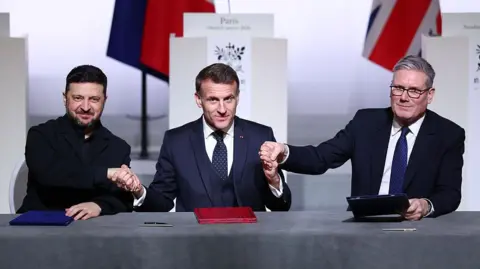
The British and French governments have inked a declaration of intent concerning the stationing of troops in the nation if a peace deal be made with Moscow, the Prime Minister of Britain, Sir Keir Starmer, has stated.
Subsequent to negotiations with Kyiv's partners in the French capital, he said that the two nations would "set up operational bases across Ukraine and erect protected installations for weapons and defense matériel" to prevent any potential invasion.
The allied nations also suggested that the US would play the primary role in verifying a halt in hostilities.
Moscow has consistently warned that any non-Ukrainian military in Ukraine would be considered a "valid objective", but has not yet responded on this recent development.
The Situation and Continuing War
The Kremlin's head Vladimir Putin initiated a full-scale invasion of Ukraine in February 2022, and Russian forces presently occupies about 20% of Ukrainian territory.
"This is a vital part of our vow to stand with Ukraine for the duration," stated the UK Prime Minister.
Top officials and senior officials from the "Coalition of the Willing" participated in Tuesday's talks.
Speaking at a combined announcement, the Prime Minister further said: "It paves the way for the juridical structure under which allied and coalition forces could operate on Ukraine's territory, protecting Ukraine's airspace and waters, and regenerating Ukraine's military for the time to come."
The British leader also stated that London would take part in any American-headed verification of a potential cessation of hostilities.
Defense Assurances and Diplomatic Positions
Lead American diplomat Steve Witkoff stated that "durable security guarantees and substantial economic promises are vital to a lasting peace" in Ukraine – mentioning a key requirement made by Kyiv.
Witkoff noted the coalition had "substantially agreed on" their work on finalizing such guarantees "to ensure the Ukrainian people know that when this conflict ends, it ends forever."
The former US envoy, US President Donald Trump's advisor, also took part in the talks.
At the same time, France's leader Emmanuel Macron said that Ukraine's partners had made "major advances" at the meeting.
He added that "comprehensive" security guarantees for Kyiv had been reached in the event of a possible truce.
Ukraine's leader Volodymyr Zelensky said that a "huge step forward" had been made in the talks, but qualified that he would only view efforts to be "adequate" if they culminated in the conclusion of the fighting.
Last week, Zelensky suggested a settlement was "mostly finalized". Settling the outstanding 10% would "decide the future of peace, the destiny of Ukraine and Europe".
Remaining Challenges
- Land and defense assurances have been at the forefront of ongoing disputes for negotiators.
- Putin has often said that Ukraine's forces must retreat from all of Ukraine's eastern Donbas region or Russia will seize it, dismissing any compromise over how to end the war.
- The Ukrainian President has to date excluded giving up any land, but has suggested that Ukraine could pull back its troops to an agreed point – but only if Russia reciprocates.
Russian forces currently controls about 75% of the Donetsk region and around 99% of the neighbouring Luhansk. The pair of oblasts form the industrial region of the Donbas.
The original US-led comprehensive peace plan that was extensively reported to the media last year was perceived by Ukraine and its EU supporters as being heavily skewed in Russia's direction.
This sparked a period of intensive diplomacy – with Ukraine, the US and European leaders trying to amend the document.
Last month, Ukraine submitted the US an revised 20-point plan – as well as separate documents detailing potential security guarantees and plans for Ukraine's recovery, he added.
